
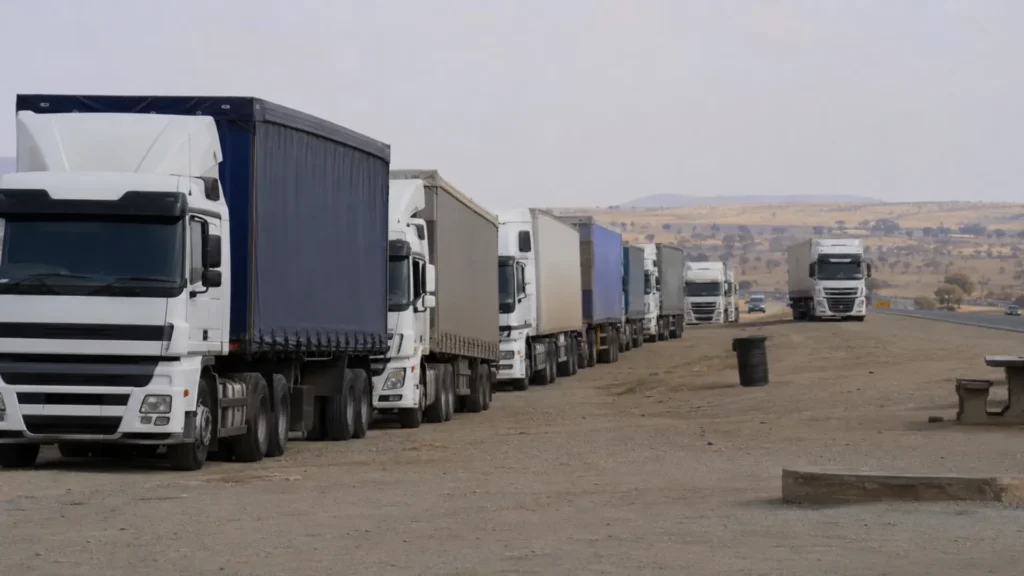
South Africa’s freight corridors faced their most anticipated test of the year today. The early picture shows 30 June freight corridor disruption that held rather than halted — corridors open, but cargo delayed and many drivers holding position. Logistics Business Africa reports that the N2 and N3 highways connecting the Port of Durban to Gauteng stayed officially open. Government had declared 30 June a normal working day. However, a truck-driver shutdown action prompted widespread precaution. Specifically, many operators told drivers to hold at truck stops until the security picture cleared. This article reports the freight-corridor impact factually. Its focus is the logistics outcome and the lessons for operators, distinct from the separate demonstrations also taking place.
Importantly, this analysis sets out what happened on the corridors today, explains the holding patterns and cargo delays operators adopted, identifies the most-affected routes, and draws the practical lessons from a day that tested every fleet’s contingency planning.
Open but Tense: The State of 30 June Freight Corridor Disruption
Crucially, the facts below are reported neutrally and attributed to their sources. This article addresses the freight-corridor and logistics dimension specifically, which is the fleet-relevant concern.
Corridors open: the official 30 June freight corridor disruption picture
According to Logistics Business Africa, the N2 and N3 highways stayed officially open, matching the government’s normal-working-day declaration. However, the threat of unauthorised blockades, sporadic disruption, and congestion pushed many operators to act cautiously. The All Truck Drivers Forum and Allied South Africa backed the shutdown. The organisation stated that national roads would not close completely. Its spokesperson noted that cargo would face delays rather than a full stop. Therefore, the day presented open-but-tense corridors. The official status and the operational reality diverged, and operators had to judge conditions for themselves.
Trucks holding: the precaution shaping 30 June freight corridor disruption
Notably, caution defined the operational response. Reports indicated that some logistics companies told drivers to hold position at designated truck stops until the security situation cleared. Observers counted a large number of trucks parked along the N3 corridor toward Durban in the days before and on the day itself. Consequently, the corridor saw holding patterns rather than free-flowing freight. This driver-safety-first approach reflects sound judgement under uncertainty. Holding a vehicle safely at a stop avoids the worst case of a blockade. It also preserves the option to resume once conditions are confirmed safe.
The industry voice on 30 June freight corridor disruption
Industry leaders urged caution throughout. Road Freight Association CEO Gavin Kelly advised employers to place staff safety at the centre of operational decisions. Additionally, private security firm Fidelity placed helicopter and drone pilots on standby and prepared armoured vehicles. It identified the main risks as road blockages, access restrictions, delivery delays, and intimidation. Accordingly, the freight sector approached the day with a clear, safety-first posture. Industry bodies sent a consistent message: prioritise people over schedules, and treat the corridors as elevated-risk until the day’s events confirmed otherwise.
The Map: Which Routes Saw 30 June Freight Corridor Disruption
Not all corridors carried equal risk. Security and freight analysts identified specific routes for heightened concern, allowing operators to concentrate their planning.
Gauteng corridors in the 30 June freight corridor disruption
In Gauteng, analysts flagged the N1, N3 and N12 corridors as freight-disruption risk areas. Specifically, the N3 through Germiston, Alberton, Heidelberg and Ekurhuleni drew warnings of freight disruption, truck intimidation, and access issues to industrial clients. The N1 corridor from Midrand to the western bypass carried a risk of blockades and delays. The N12 around Benoni and Boksburg added industrial-spillover risk. Consequently, operators serving Gauteng’s industrial hubs, including Kempton Park, Isando and Benoni, focused their planning on these routes and the access roads to client sites.
KwaZulu-Natal and port routes in the 30 June freight corridor disruption
In KwaZulu-Natal, analysts flagged central Durban, Pietermaritzburg, and the N3 near Mooi River for possible truck blockades and freight delays. Importantly, the routes serving the Port of Durban drew particular attention. The port acts as the gateway connecting to Gauteng and regional markets. The N3 is South Africa’s primary freight corridor, so any disruption there carries outsized consequences for national supply chains. Therefore, KZN-based operators and those running the Durban-Gauteng corridor treated these routes as their highest priority for monitoring and rerouting readiness.
Border and regional routes in the 30 June freight corridor disruption
Beyond the main corridors, border and regional routes also featured. Analysts flagged the Musina-Beitbridge route in Limpopo and the Komatipoort-Lebombo crossing in Mpumalanga for possible delays and freight congestion. Additionally, Free State transit routes around Harrismith, where the N3 and N1 connect, carried spillover risk. Consequently, cross-border operators and long-haul fleets factored these points into their planning. The breadth of flagged routes underlined a national risk, even though the most acute concern centred on the Durban-Gauteng freight spine.
The Cost: What 30 June Freight Corridor Disruption Means Financially
Even a day of holding rather than halting carries a real cost. Disruption short of a full blockade still hits operators in measurable ways.
The direct costs of 30 June freight corridor disruption
Holding trucks at stops carries immediate costs. A parked vehicle earns nothing while driver wages, financing, and standing expenses continue. Furthermore, delayed cargo can mean missed delivery windows, penalties, and knock-on scheduling disruption over the following days. Perishable loads face particular risk if delays extend. Consequently, even a calm day imposes a cost on operators who held back. That cost stays far smaller than a vehicle caught in a blockade. The holding decision trades a known, smaller cost against an avoided, larger risk.
The wider economic dimension of 30 June freight corridor disruption
At a national level, the stakes ran high. Economists had warned that a high-impact shutdown could cost the economy up to R17 billion. It could also threaten tens of thousands of short-term jobs in logistics and related sectors. The held-not-halted outcome appears to have avoided the worst case. Even so, the precautionary slowdown still represents lost productivity across the freight network. Therefore, the day showed both the vulnerability of concentrated freight corridors and the value of the preparation that kept disruption contained.
The Lessons: What 30 June Freight Corridor Disruption Taught Operators
A test day like this one offers concrete lessons. These apply directly to any future corridor-disruption event, of which this is unlikely to be the last.
Preparation proved its worth in 30 June freight corridor disruption
First, preparation paid off. Operators who pre-planned alternative routes, briefed drivers, and monitored conditions navigated the uncertainty far better than those who improvised. The month of rehearsal through the Comrades closure and the Bafana overnight matches gave prepared fleets verified data and tested protocols. Consequently, the difference between a calm day and a chaotic one often came down to the planning done in advance. The day rewarded foresight and punished complacency, exactly as contingency planning predicts.
Visibility was decisive in 30 June freight corridor disruption
Second, real-time visibility proved decisive. On a day when a corridor’s status could shift within an hour, operators who could see exactly where their vehicles were, and what lay ahead of them, made better hold-run-reroute decisions than those relying on phone calls and rumour. Furthermore, the ability to reroute quickly around a developing situation turned potential losses into manageable delays. Live tracking and geofencing were not luxuries today; they were the tools that separated a managed response from a reactive scramble.
Safety-first was the right default in 30 June freight corridor disruption
Third, a driver-safety-first posture was vindicated. Operators who held drivers at stops when uncertainty was highest protected their people and their vehicles, and lost only time. Finally, the gap between official and actual status mattered. Roads can be open officially while still carrying real risk, so operators who judged conditions on the ground rather than on the declaration alone made sounder calls. Trusting verified, real-time information over any single official statement proved the wiser approach throughout the day.
Technology That Managed 30 June Freight Corridor Disruption
Notably, today demonstrated exactly which technology capabilities matter when freight corridors face disruption without a predictable pattern.
DigitFMS integrates GPS tracking with geofencing, AI dashcams with cloud upload, panic buttons, real-time route management, and depot monitoring on one dashboard. When a corridor situation developed today, geofencing alerted operators to vehicles approaching flagged zones, and route management enabled rapid rerouting. The GPS view showed which vehicles held, which moved, and which needed redirection. If a driver faced confrontation, the panic button offered an instant link to the control room. The dashcam documented any incident for insurance. The KwaZulu-Natal franchise operators provided regional intelligence on the Durban and N3 corridors at the centre of the day’s concern.
Equally, Cartrack, Tracker, Netstar, Ctrack, and MiX by Powerfleet provide comparable tracking and security platforms. The decisive capability for 30 June freight corridor disruption was real-time situational awareness. That means knowing where every vehicle sat, what lay ahead, and how to respond as conditions changed. Operators with that awareness managed the day with composure, holding and rerouting on solid information. Those relying on rumour navigated blind on the day reliable, live data was worth most. The day made the business case for corridor visibility clearer than any argument could.
Outlook: 30 June Freight Corridor Disruption Is a Template, Not a One-Off
By mid-afternoon, the freight corridors had largely held. The N2 and N3 stayed open. A feared total blockade of the Durban-Gauteng spine had not materialised as a national shutdown. Instead, the dominant operational story was one of caution, holding patterns, and localised delay rather than catastrophic disruption. For a freight sector that braced for the worst, a contained outcome is a relief.
However, the day works better as a template than a one-off. The same corridors, the same pressures, and the same organising capacity remain in place. The freight-sector grievances behind the truck-driver action stay unresolved. Consequently, the contingency capabilities operators built and tested today keep their value well beyond 30 June. The next corridor-disruption event, whenever it comes, will reward the same preparation, visibility, and safety-first judgement that served operators well today.
Ultimately, 30 June freight corridor disruption delivered a clear message. South Africa’s freight network is both vital and vulnerable. The operators who manage it best are those who prepare, watch, and stay flexible. Today the corridors held, helped by heavy security, industry caution, and a great deal of careful planning. The fleets that navigated it calmly had done the work in advance. That lesson, more than any single day’s outcome, is what operators should carry forward. The corridors held today. The discipline that held them is what will matter next time.
Frequently Asked Questions
What happened to freight corridors on 30 June?
The major corridors, including the N2 and N3 connecting Durban to Gauteng, stayed officially open after government declared a normal working day. However, a truck-driver shutdown led by the All Truck Drivers Forum and Allied South Africa prompted precaution. Reports showed drivers holding at truck stops along the N3, cargo delays, and tension on the N1, N3 and N12 in Gauteng. The corridors held rather than halted, marked by caution and localised disruption.
Were the roads closed on 30 June?
The national roads were not officially closed. Government confirmed a normal working day, and the major corridors stayed open. The truck-driver organisation behind the action said national roads would not be completely closed, with cargo delayed rather than stopped. The risk was unauthorised blockades, sporadic disruption, and congestion rather than formal closure, leaving operators to judge whether to run, hold, or reroute.
Why did some operators hold trucks at truck stops?
Because the day’s outcome stayed uncertain, some companies told drivers to hold at designated stops until conditions cleared. This is a standard precaution when corridor risk is elevated but unconfirmed. Holding safely avoids a blockade while preserving the option to resume once conditions confirm safe. It reflects a driver-safety-first approach, prioritising people and cargo over schedule on a high-uncertainty day.
Which corridors were most affected?
Analysts flagged the N1, N3 and N12 in Gauteng, particularly around Germiston, Alberton, Heidelberg and Ekurhuleni. In KwaZulu-Natal, the N3 near Mooi River and the routes serving Durban and its port were highlighted. Border routes including Beitbridge and Lebombo were flagged for possible delays. These were where operators concentrated contingency planning, monitoring, and rerouting readiness.
What did the day teach fleet operators?
Preparation pays: those who pre-planned routes, briefed drivers, and monitored conditions fared best. Real-time visibility is decisive when corridor status changes quickly. A driver-safety-first posture, including holding when needed, is the right default under uncertainty. And the gap between official and actual road status matters, so judge conditions on the ground, not on declarations alone. These lessons apply to any future corridor-disruption event.
What is the difference between the truck shutdown and the immigration protests?
They are separate actions that coincided on 30 June. The truck-driver shutdown, led by the All Truck Drivers Forum and Allied South Africa, is a freight-sector action about trucking-industry conditions, and it directly targets freight corridors. Different groups organised the separate demonstrations around different grievances. For fleet operators, the freight-corridor dimension is the relevant concern, and this article focuses on that logistics impact.
How does technology help on a day like 30 June?
Real-time GPS tracking shows where every vehicle is relative to flagged corridors. Geofencing alerts when a vehicle nears a risk zone. Route management enables rapid rerouting. Panic buttons connect drivers to the control room instantly. Dashcams document incidents for insurance. Together these give operators the awareness to make informed hold, run, or reroute decisions in real time. That live edge is decisive when corridor status shifts hour by hour.
Sources
Logistics Business Africa — “Freight operators on high alert as June 30 protest threatens disruption at Durban Harbour and key logistics corridors”, 29 June 2026; N2 and N3 officially open, ATDF-ASA Gugu Sokhela “cargoes will be delayed”, drivers held at truck stops, Zambian-registered trucks parked on N3, RFA CEO Gavin Kelly on staff safety · Kempton Express / The Citizen — “High-risk zones identified nationwide ahead of June 30 marches”, 29 June 2026; N1, N3, N12 corridor risks, Gauteng logistics hubs, border routes Beitbridge and Lebombo, Kempton Park CPF
BusinessTech — “30 June protest hotspots in South Africa, from highest to lowest risk”, 30 June 2026; Arrive Alive risk list, N3 near Mooi River, central Durban and Pietermaritzburg, medium-risk OR Tambo logistics precinct and N1/N3 Harrismith · IOL — “June 30 protests: Cachalia says SAPS is ready”, 24 June 2026; N3/N1/N2/N12 corridors, Fidelity CEO Wahl Bartmann helicopters drones APCs, road blockages and access restrictions and delivery delays, R17bn and 85,000 jobs economist estimate · News24 / NovaNews — 30 June live updates, corridors monitored, visible policing
DigitFMS — 30 June shutdown fleet contingency eve briefing (29 June), 30 June shutdown fleet readiness final checklist (26 June), Comrades N3 reopening fleet dress rehearsal (15 June), port congestion fleet costs Richards Bay (26 June); freight corridors, contingency, real-time visibility, rerouting. Note: this article addresses the freight-corridor and logistics dimension of 30 June. Separate demonstrations on the day are reported by general news outlets and are beyond this article’s operational scope. Corridor conditions were still developing at publication; operators should verify the latest position through official channels.
© 2026 DigitFMS. All rights reserved.